
I believe a leaf of grass is no less than the journey-work of the stars… —Walt Whitman, Song of Myself, 31
What an exciting time of the year to be preparing for the upcoming NW Flower and Garden Festival.
We’ve slid into Winter Term at school and the winter chill is upon us as I prepare the final touches on my presentations. (Click here to see all of the folks who’ll be at the show.)
I just wanted to take some time here on my site to look more closely into the professional interests of some of the judges who’ll be in attendance at the show. I’m not very familiar with a few of them, so up first, Neil Lucas.

In a roundabout way I really just want to say that I enjoyed examining the reissue of his book Grasses for Gardens and Landscapes. I didn’t have time to read the whole thing cover to cover, but I looked through it to see what I thought of it as a resource, and compared to the original edition, the photos are helpful, and overall, it’s pretty and a well-written book.
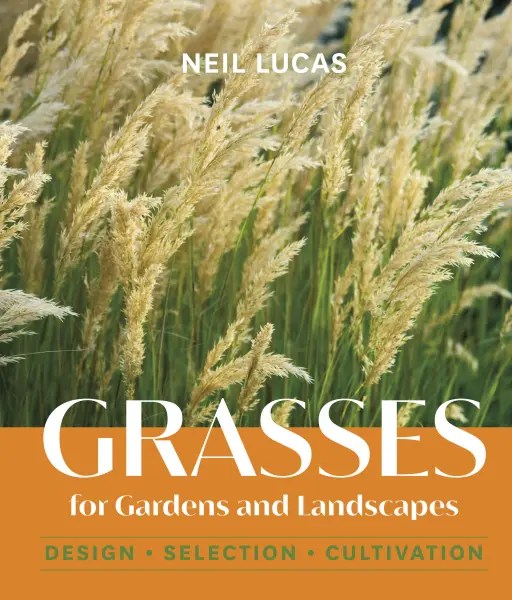
In addition to judging the gardens, he will also be speaking at the show. His first talk will be on 2/19 at 10 am, “Grasses for a Greener World; Grasses and the Wider Environment”. Lucas will speak again on 2/20 at 11:30 am. That talk will be “More Wow and Less Work; Grasses and Their Place in our Gardens.” and if you’d like to enjoy an even deeper conversation there will also be An Evening with Neil Lucas at NWFGF: Grasses and the Naturalistic Approach at Knoll Gardens.
Luckily, not long after I started to draft this entry, Lorene wrote this great piece for The Seattle Times: A guide to the verdant perks of gardening with ornamental grasses.
I’ll let you read that and I’ll continue on with my thoughts here on my site.
I came of age as a gardener some 20 years ago, but was mentored by a man who long ago told me that re-planting prairies and oak savanna would become widespread someday. In the early 1980s, we’d lie on our stomachs in the overgrown non-native weedy grasses on his property, watching what was going on around us for what felt like a long time. Learning to watch stuck with me, and apparently my mentor’s love of soil science has remained as well.
Later, as an adult, when I was a gardener/blogger, and before I worked in horticulture, ornamental grasses were quite popular, and the ecological plantings that are very common now, were just pushing through in magazines and planting projects in different regions in the US.

I’ve watched since the 1990s as landscape design and the science of ecology have moved closer and closer to one another. And while the economic benefits of selling undeniably more ecologically responsible plantings has promoted the popularity of certain designers and styles, it’s continued to cause certain divisions to persist.
I’m not going to go into this other than to put it simply. There’s ornamental horticulture, and there is the world of native plants and sustainable landscapes that allow for differing degrees of deviation. I work between these worlds, and have friends who’re representative of many schools of thought. For this reason, it’s funny to admit, but I’ve never really “gotten into” ornamental grasses other than to have propagated hundreds if not thousands of them now at different nurseries.
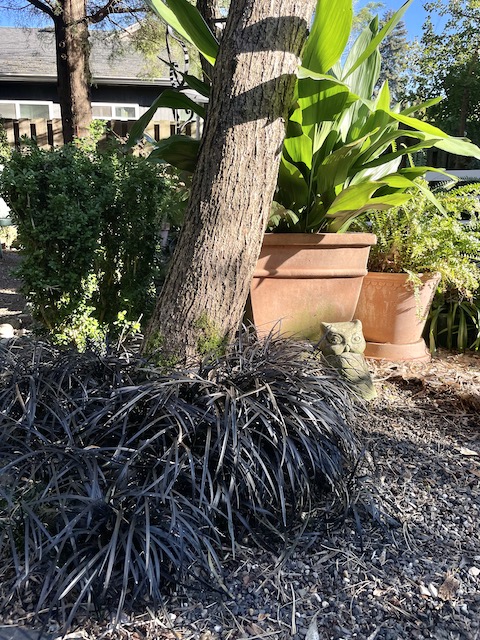
I’m just a skilled laborer in all of this, an observer, actively stepping away from all of that just to responsibly supply the material. And provide it I have, whist wryly smiling from the wings.
The arena of ornamental grasses can be an interesting one.

At the heart of our concept of gardens is the landscape we grew up in, and for me, that space has always involved wild areas that are near streams and rivers, and which sometimes still have native grasses incorporated into them, but oftentimes they’ve been disturbed by human activity and development. Nevertheless, these views have been imprinted on me. I spent most of my childhood looking for the differences and thinking about how we’ve changed the landscape over time.

As I’ve grown older, and am more experienced, I’ve had time to play the Is-it-or-isn’t-it? native grass game. And while I joke about not being a great botanist, if you want to improve your skills, this is a great area to play around in when you have the time and mental energy to key things out.

Not all native grasses will do well in our home gardens, and because of that, we’ve learned to replicate looks we’ve seen elsewhere with products we can buy. Add to that, plant shopping is fun and we plant what we have access to from local nurseries. In our climate, some planting designs will need more water than others, but there are many ornamental grasses that can be very easy to care for with few extra resources.

But most of us are home gardeners, and I’m one too, but I don’t own an estate. I love all plants, and I don’t have a lot of space to spare on my city lot. I plant anything I want mostly “for science” as my horticulturist friends and I like to say. I also grow things to get small fresh crops of their seeds. I trial anything and everything. Hence, why I have one of everything.

I plant plants because I like to watch and observing them calms my mind. I want to trial things, watching to see what their lifespans looks like. If I like the stories they have to tell while held captive on my small plot of land, then I write about them in my own words.
Most importantly though, I want to know if they play well with others.
Most folks want their gardens to look nice though, and I have to be honest, well thought-out ornamental grasses, planted with good spacing, while paying attention to their requirements, can be simply stunning year-round. I think we often take them for granted since we see them so often in public spaces where they often do well.

At work, I’ve seen many photos and lists of grasses customers and designers have either used or wanted to acquire. I can’t count how many times I’ve seen and overlooked clumps of different kinds of grasses in the landscape.
This year I’ve decided I’ll give more a chance, especially in spots that have challenged me.
Some will be natives I want to trial more.

There are the ornamental grasses too that you don’t see often, and you wonder what it is about them that didn’t work well in the garden landscape, and how they can be re-introduced into the market more broadly so folks can be more successful with them.
I remember everyone wanted and tried this one, but no one has it any more. Usually this happens when a plant is sold and gardeners can’t give it the exact conditions it needs to be cultivated successfully. This can happen when the plant is not trialed enough, or if it’s one that is unsuitable for a wider market.
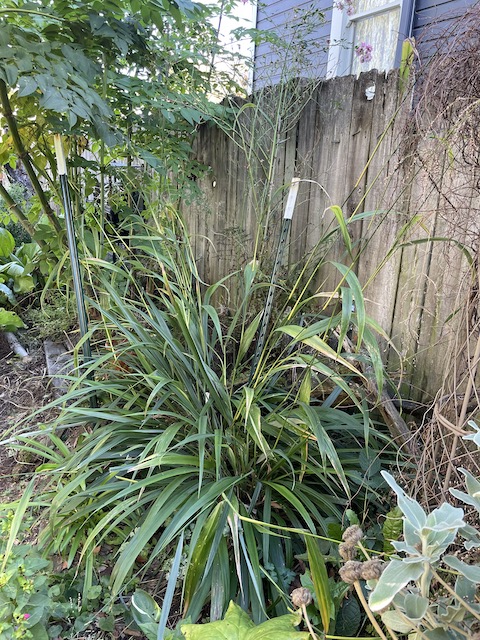
I’m trialing a few other grasses around home, but this is the only other one that’s fun right now. I received this from Evan, who’d gotten it from another friend, and I need to check in with her to see how it’s grown in her garden in WA. Before I talk about how amazing this plant is that the Beth Chatto’s Plants and Gardens has on its site, I want to know if it’s a weed here. Based on the number of seeds I collected from it, I have some concerns.
Check back with me later though. I’ll let you know how it’s progressed.
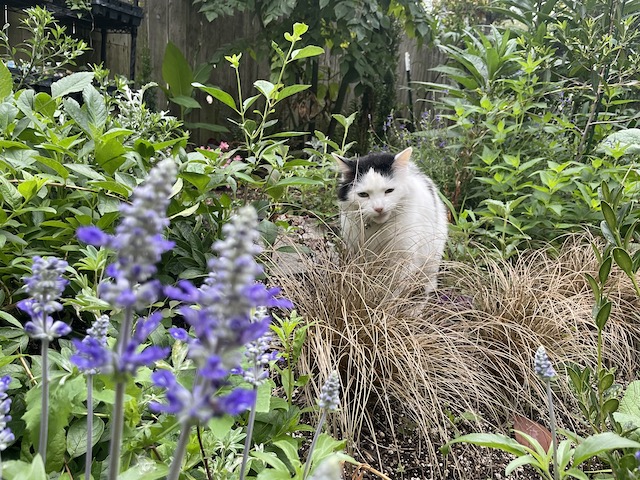
By now you have noticed that I like certain grasses and that I have to keep certain groups out of the garden because of pest damage, mostly from LuLu. But what you may not have picked up on is that I DO like native grasses, and I do believe they should be used—but the whole inclusion is very complicated.
There are a lot of fine lines here again between landscape design, ecological plantings, plant material accessibility, suitability, reliability, and let’s just throw in things like conservation. When you start to mess with grasses in the landscape, it can become a Pandora’s box depending upon where you live.
It can also be a huge opportunity for growth beyond what’s come before.
I quietly do a lot of due diligence and recommend that you do the same.
The more you know, the better you’ll grow.
[Photo at the top of this post is of a grouping of Calamagrostis x acutiflora ‘Karl Foerster’ in my neighborhood. The look is quite clean, modern and dramatic.]


Leave a comment