Last Friday I graduated from Clackamas Community College, and I’ve been able to take some time off to rest and get my life back on track. I’ve been spread thin for the last two years—so thin I think that my veneer of calm was seriously cracking recently. It was just burnout though, and after sitting in a chair for a few days, editing photos, I decided to begin to clean up the piles surrounding me.
In the dining room there was a mailed reminder to renew my membership to The Gesneriad Society. In my home office I had homework from the last 3 terms. Next to my bed there were sheets of things I’d printed out to research. I’ve found information related to work all over the place. Then there were a few gifts from my birthday 9 months ago and Christmas. Maybe I should write some thank yous?
It was time to sort this all out—and I’m glad a planned trip to Washington didn’t work out. I’m nowhere near being done cleaning, but at least it’s started. I plan to purge a great deal this summer.
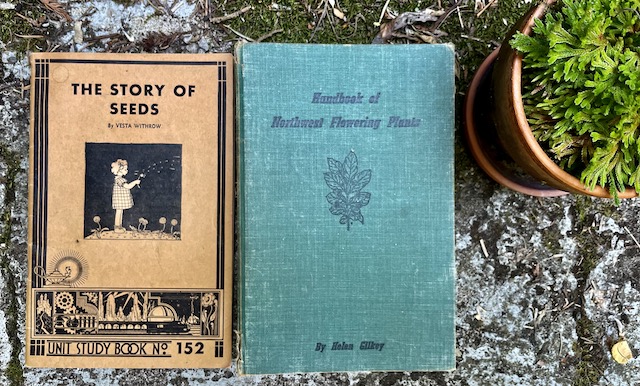
I added two vintage books from my gift pile to the blog post pile. There’s no shortage of things to write about now that school is finished. Later in the evening, I spent time reading through them both at bedtime. Thinking about their development, ownership, and journeys—as well as my own.
I brought the books back downstairs to write about them yesterday, and then to my surprise in the afternoon, Loree messaged me to let me know that she was going to drop something off on the porch. She’d given me one of the books—Alexa, the other. That’s when I knew it was an inevitable sequence of events leading up to this post.
Kismet.
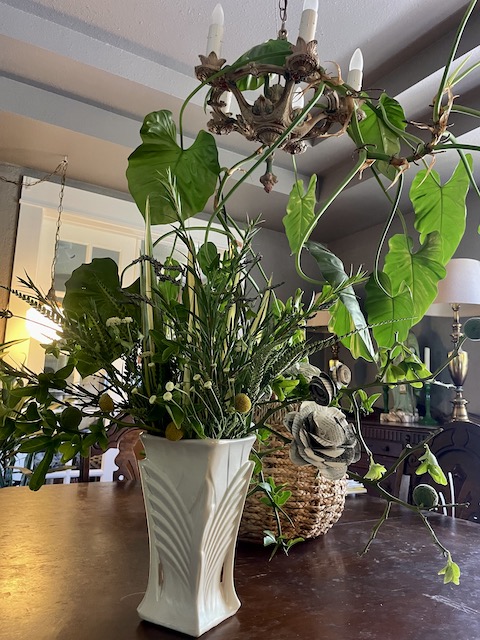


And what an amazing surprise—a Loree Bohl original arrangement. Yay!!! Considering how much I’ve gone through to graduate, it was a heart-warming gift to receive. I love it and have to say again, Thank You!
Loree and I have been friends for a long time now, she’s seen me go through a lot, and knows me well. While we both have different styles, many of our favorite plants overlap and she included them in the arrangement. (Yes, I like prickly and dangerous plants too if you didn’t know.) Back when we first met, I was known online more as Ficurinia, Sicilian dialect for prickly pear. So of course an Opuntia card made complete sense.
I thanked her again for the vintage book from months ago, and told her I was just starting to write about it, but I was yet in a bit of awe of the vintage vase and arrangement that she’d brought me. It was perfectly thought out, with special plants, and I DO love vintage pottery so, so much. This vintage McCoy will be loved and honored for years to come. It can be my floral trophy.

Months back she posted about the The Story of Seeds she found in a bookshop in North Hollywood. (To see the whole thing, I recommend you check out the link.) It’s an adorable, informative, and sweet look at the life of seeds that’s seldom seen. Reading it, I felt a bit like a kid. It felt nostalgic and transported me back to my childhood home, where if I wasn’t outside roaming around, I was inside reading. It also reminded me of my age, and how the childlike wonder I shared with my classmates was often so different since so many of them were younger and had learned more online about plants. I still really struggle with that and prefer books.
I also learned about plants from the grandchildren of Oregon Trail pioneers. My first teachers were my Grandma Virginia and her neighbor Mr Palm. We used books and stories, and my lessons were always outside. I was always outside. Watching. Listening. Playing. I still very much believe in plant knowledge being passed through oral tradition, and through practice. It’s part of why I love horticulture so much.
Online learning, and “let me look that up on my phone” just isn’t quite the same. Maybe the gap in time it can take for someone to walk away from the conversation, to look the thing up in a book, to research it, to remember that they wanted to share it with you in the next conversation, is a healthy and natural process. I find that considerate and somehow human. I enjoy showing that I’ve given someone careful thought, and some of my time.
Online learning often blunts this process for me. Are you performing knowledge and spitting it out, or are you connecting and are we building rapport? Sometimes I was left unsure.

The book was fun to read, reminding me of seeing the natural world with more innocence, and less to please my eye. Having overfed my mind recently by gorging on technical information at school, I look forward now to pleasing my eyes again here at Campiello Maurizio. I plan to relax more and have conversations like this one with the ants.
I especially enjoyed the pages with experiments and riddles. I did all of these projects as a kid, and played all of the games. The voices of the seeds, while anthropomorphic, remind me now of the handful of Native American students who bravely reminded us again and again in classes that the natural world is part of our community too, and is not something separate from us.

Best of all was the quiz at the end of the booklet. I thought I was tired of being tested after my seemingly gazillionth final, but I jumped at taking this one. It was clever, and I especially liked to roll around the Wrong answers in my mouth, for the sake of a good giggle.
My favorite one leads us to the second book, it’s that last one on this page… Some seeds are like… men. Lol.

The second book was given to me by Alexa, and it’s one I’d looked at before but I didn’t yet own. It’s the Handbook of Northwest Plants by Dr. Helen Margaret Gilkey—an older edition.
I’m not sure Alexa knew how much this amazing woman meant to me, but she was a trailblazer and a woman of the PNW I greatly admired and wanted to be like when I was a wild young girl. I say Dr because she was the first woman to receive her Ph.D. in botany from the University of California. As a girl, I deeply admired any female academic.
While not the childhood hero to me that Lilla Leach was, when I was 18 the plan was to study either Ecology at Duke University, go to CCC to get a transfer degree to study Botany at OSU, or go to Lewis & Clark College to study Biology and English and to somehow double major in them both to work with the natural world and write about it. Dr. Gilkey was someone who inspired me as a woman to do more than what was expected of me as a woman.
I ended up on the third path, but had to leave LC after a year and half, and I ended up with a BA from PSU, and not the BS, so when considering going back to school at my age, I went for the AAS since to go for a Master’s now, would be very complicated and expensive. My only option would be a MAIS or Master of Arts in Interdisciplinary Studies and you can all imagine how impossible it would be to find funding for such a thing. It would have to be a customized program combining classes from different programs to suit my objective.
Don’t think I haven’t thought about it. OSU has such a program, and I’ve looked into it. I even talked to a former boss who is a Senior Instructor at OSU in Agricultural Sciences about how I could do it. Just that one conversation felt like a door opening, and not a door being closed, so it may have been enough. I don’t know. I will at least go so far as to design a few ideas of what I would have liked to have studied.
I folded all of these thoughts into the pages as I read. To save money, maybe I can just write about those objectives and not worry about a graduate program. This is the most likely pathway forward for me. Kneading the dough of my future into the book…


Books that are this old, used, and marked up always have me going to the internet. I found the obituary for the husband of the couple who’d stamped their names on the front page. I believe this was used more by Irene though than it was Keith since the notes seem to be written in feminine cursive. They lived in Eugene and had met in the Peace Corps.
We see above that she wrote down the name Donn Park along with the name of a building at Oregon State University. I wonder why. From his obituary I learned that he was a lifelong fisheries research scientist and he later created Biomark, a company that is a worldwide leader in tracking fish.
And I continued sinking into the pages, the plant families, the keys, seeing the plants in my mind’s eye as I see their names on the page, and I think back to the many times and places I’ve seen them. For me, it’s still difficult to take the more abstract scientific information from the page and connect it to the silent primal me who’s some kind of mute sponge soaking up information when I go out to botanize.
Whatever it is that I do, I wouldn’t call it botanizing, but I will find the words someday to describe it. It’s an instinct inherited from my father, some have called it that of a hunter, but one famous regional author called my dad an addict once. “The tug is the drug,” referring to fishing. Since then, I’ve had to think long and hard about that.
Back on November 15, 2022 I attended a meeting for the Native Plant Society of Oregon Portland Chapter at PSU, my alma mater. At the event, we were able to visit both the Portland State University Herbarium as well as the Rae Selling Berry Seed Bank and Plant Conservation Program. I found myself feeling many feelings about never having visited the herbarium while a student there. It was an emotional block from not having been able to take the path I’d wanted to while my childhood friend had gone to OSU and become a botanist. Pangs of regret, coupled with humor. I studied Art History because I couldn’t draw. One more reason I could not have studied botany. Yet now I find myself wanting to draw more and garden less. Go figure.
As we toured, I wondered if they’d let me volunteer there for CWE (community work experience) for credit if I returned to Clackamas Community College to complete the horticulture program. At that time in 2022 I was feeling certain I had to complete the program. I really envied the students at PSU though who could work and study in these rooms.
As we walked around looking at the sheets, I saw a mounted specimen and felt the fangirl in me as I shivered a little bit with excitement. There is was. Helen Gilkey had collected this, or had she just mounted it? I remember being a bit giddy and the woman giving us the tour realized my excitement and then I looked over at the poster on the wall and acted even more impressed. I hate myself when I do this, but oftentimes, I just simply can contain it. With age, I seem to care even less.
I was exuberant in the herbarium and not in a way that’s likely commonly seen there.

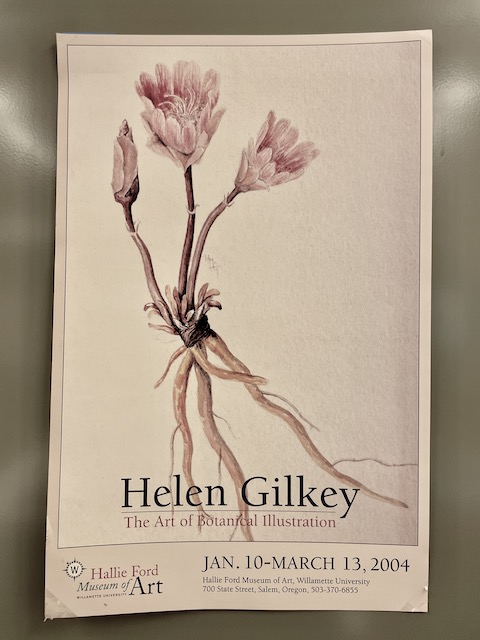
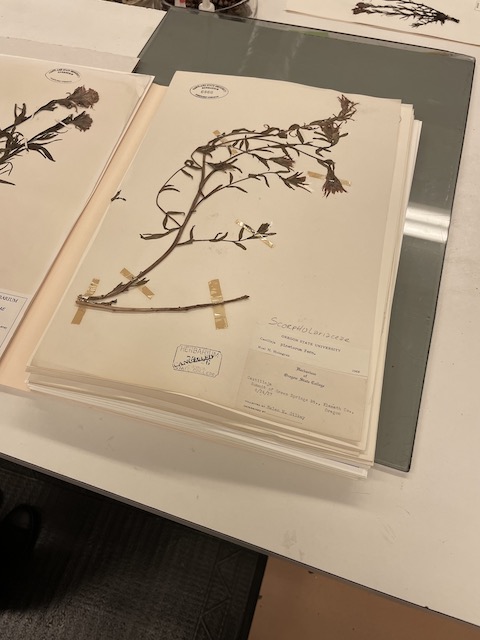
To offset my own awkwardness I remarked on the Helen Gilkey: The Art of Botanical Illustration poster. I made a joke about not being able to draw. How I’d wished I’d attended the exhibit. Then I silently retreated and thought about how ill I was in 2004. Sometime after that though, my childhood friend gave me her mobile plant press as she transitioned to become a therapist. She’d used the press in the field for botanical specimens.
Only recently have I pulled it out from the basement and put it on display in my office. I’ve not yet used it, but I plan to soon.
So there I was last year, 9 months ago, turning 50 with two vintage books rooted in my past—both connecting and grounding me, given to me by friends who I’m sure in their own way knew their gifts would touch me, and they did.
I think I just had to graduate again to really let the lessons sink in like a gentle rain shower in a garden.
Thank you both.


 Ann Loves Plants
Leave a comment